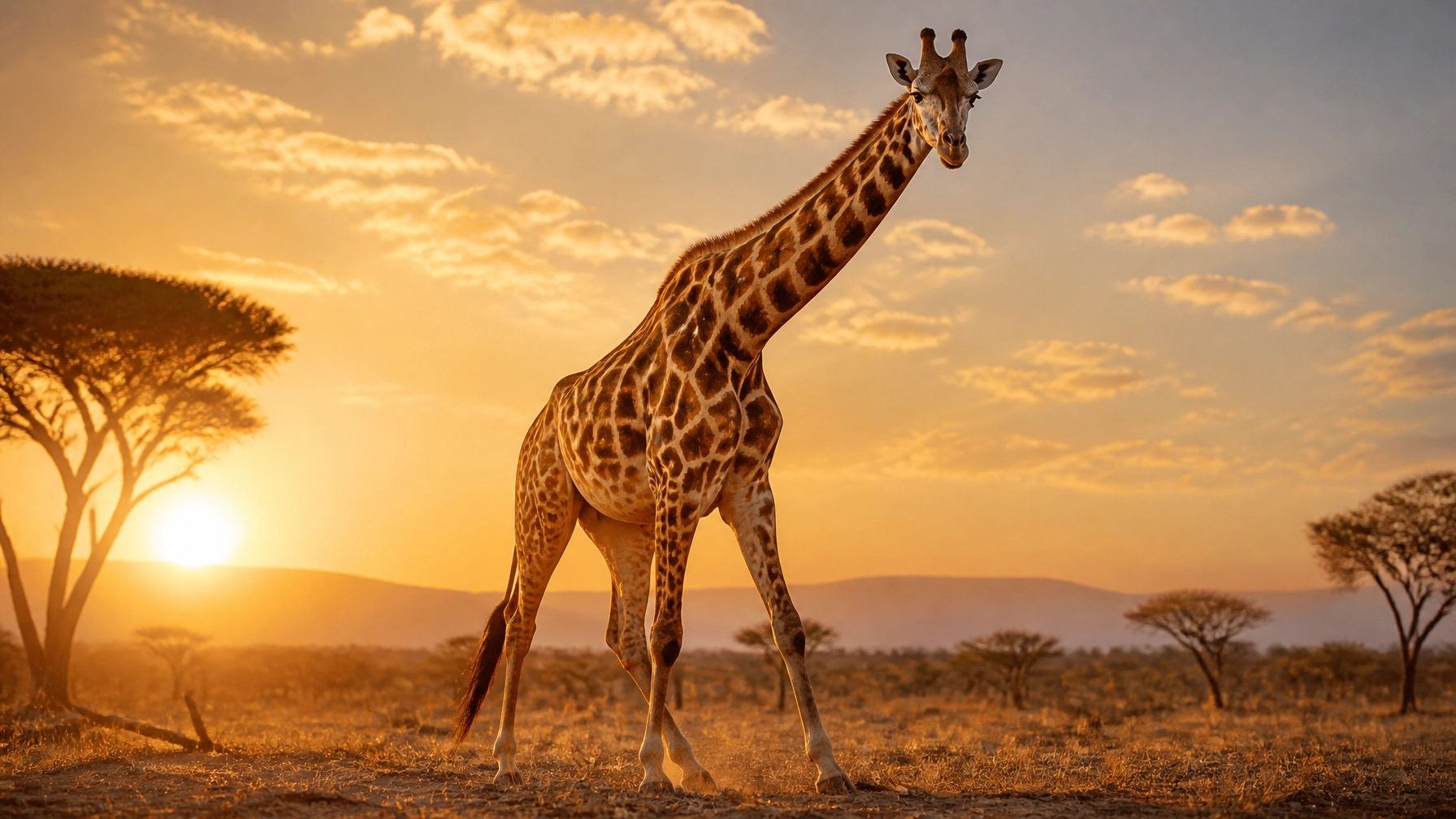
Presented by: Giraffes : The Silent Comeback Story
The tallest land mammal.
A silent icon of the savannah.
For decades, their numbers slipped away quietly.
A "silent extinction."
Now, the narrative shifts.
2025 marks a turning point.
Research confirms it.
The giants are returning.
The New Taxonomy
Science evolved.
As of 2025, we no longer speak of "the giraffe."
We speak of four distinct species.
- Northern Giraffe (Giraffa camelopardalis)
- Reticulated Giraffe (Giraffa reticulata)
- Masai Giraffe (Giraffa tippelskirchi)
- Southern Giraffe (Giraffa giraffa)
Different patterns. Different regions. One shared hope.
The Numbers: A Global Recovery
Total wild population: ~140,000.
Higher than previous decades.
A result of better surveys.
A result of dedicated protection.
The growth is measurable.
- Southern Giraffes: Up ~50% in five years.
Current estimate: 68,837.
The strongest recovery. - Reticulated Giraffes: Up ~31%.
Current estimate: 20,901.
A significant rebound in East Africa. - Northern Giraffes: Up ~20%.
Current estimate: 7,037.
Still critically endangered.
But moving in the right direction. - Masai Giraffes: Stable.
Current estimate: 43,926.
Holding the line.

Behind the Lens: Capturing the Giant
Photographing giraffes requires more than a long lens.
It requires a shift in perspective.
They are calm.
They are also powerful.
Technical Guide
1. Portrait Framing
Don’t just shoot the whole animal.
Focus on the head and neck.
Capture the "micro-expressions."
The heavy eyelashes. The prehensile tongue.
Use an 85mm to 200mm lens.
Shallow depth of field.
Let the background fade.
2. The Golden Hour
Giraffes and amber light.
A perfect match.
Early morning. Late afternoon.
The low sun highlights the texture of their coat.
It adds depth to the patterns.
3. Focus on Patterns
Every giraffe is unique.
Like a human fingerprint.
No two are identical.
Capture these "fingerprints" in close-up.
Abstract shots of the flank.
Geometry in nature.
4. Sunset Silhouettes
The most iconic shape in the wild.
Wait for the sun to drop below the horizon.
Underexpose your shot.
Focus on the outline.
The long neck against a fiery sky.

Field Notes: The Photographer's Experience
Patience is the primary tool.
Giraffes observe you as much as you observe them.
They look gentle.
They can kick with lethal force.
Respect the distance.
Wait for them to settle.
The best shots happen when they forget you are there.
Our Partner: Giraffe Conservation Foundation (GCF)
Recovery doesn't happen by accident.
It happens through action.
The Giraffe Conservation Foundation (GCF) is the driver.
They are the only organization in the world that concentrates solely on the conservation and management of giraffes in the wild throughout Africa.
Their impact in 2025:
- Securing habitat.
- Translocating populations to safe zones.
- Anti-poaching initiatives.
- Community education.
Support their mission.
View their work at giraffeconservation.org.
The ZooMedia Advantage
Zoos and aquariums play a critical role.
Education leads to conservation.
Our ZooMedia.us app bridges the gap.
- User-Generated Content: Guests take photos.
- Engagement: Guests share their stories.
- ROI Tracking: Zoos see real-time impact.
- Marketing: Authentic photos drive more visitors.
When a guest shares a photo of a giraffe, they share a message of survival.
We provide the tools to make that message viral.

Why Quality Imagery Matters
Stock photography is often generic.
We offer authenticity.
Stunning animal photography.
Save time.
Save money.
Impact your audience.
Whether you need a landscape for a billboard or a portrait for an app, we have the category.
Polar bears. Tigers. Lions.
And, of course, the recovering giraffe.
The Next Chapter
The "silent extinction" is over.
The "silent comeback" has begun.
140,000 strong.
Four species.
One goal.
Explore our full library of giraffe imagery.
High-resolution.
Natural lighting.
Ready for your project.
Action: Visit Zoo Imagery
Connection: Follow us on LinkedIn


