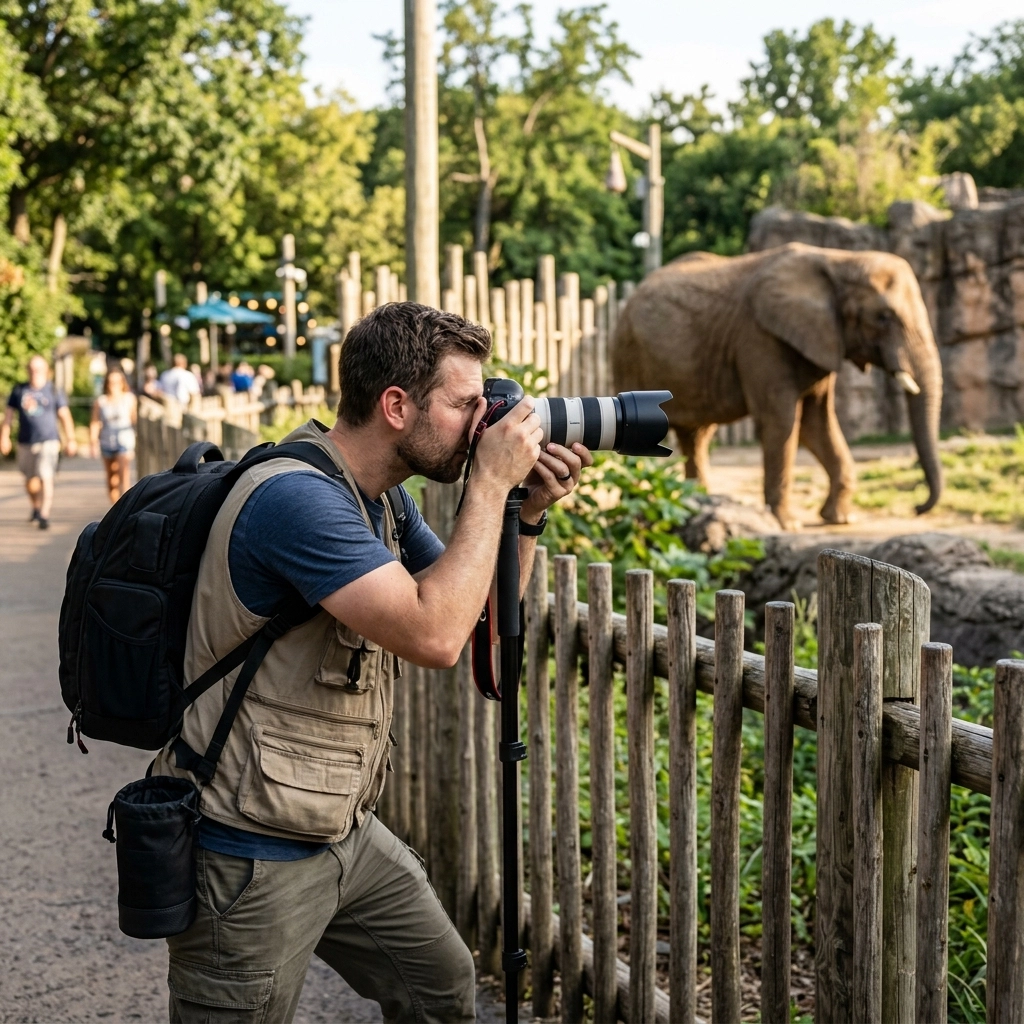
7 Mistakes You’re Making with Your Zoo Animal Photos (and How to Fix Them)
Great photography moves people. In the world of zoos and aquariums, a single image can drive a donation, spark a conservation conversation, or sell a membership. At Zoo Imagery, we see thousands of files. Most are good. Some are great. But many fall into the same traps.
If your "Presented by" animal pages or sponsored species spotlights aren't getting the engagement you want, the photos might be the problem.
Here are the 7 most common mistakes we see and exactly how to fix them.
1. Including Too Much "Zoo"
The goal is the animal. The mistake is the environment. Chain-link fences, concrete walls, and green exit signs kill the magic of a wild encounter.
When a corporate partner sponsors a species spotlight, they want to be associated with the majesty of the animal, not the maintenance of the enclosure.
The Fix:
- Use a wide aperture. Set your f-stop as low as it goes (f/2.8 or f/4). This blurs the background.
- Get close to the barrier. If you are shooting through glass or mesh, put your lens directly against it. It disappears.
- Check the corners. Before you click, look at the edges of your frame for trash cans or signs.

2. Shooting from a Human Perspective
Most people take photos from a standing position. This creates a "looking down" angle. It makes the animal look small and distant. It lacks emotional impact.
For high-quality elephant photography, perspective is everything. You want to look up at them to show their scale, or at least meet them at eye level.
The Fix:
- Crouch down. Get on your knees. Get to the animal's eye level.
- Find the connection. Photos where the animal is looking directly at the lens create a bond with the viewer.
- Wait for the sit. If an animal is on the ground, you should be too.
3. The "Blurry Paw" Syndrome
Animals move. Even the slow ones move faster than you think. A slow shutter speed leads to motion blur, making the photo look amateur and unusable for high-end digital media.
Whether you are capturing wild tigers or a jumping lemur, sharpness is non-negotiable.
The Fix:
- Up the shutter speed. Keep it above 1/500th of a second for resting animals.
- Go faster for action. If birds are in flight or tigers are pacing, move to 1/1000th or higher.
- ISO is your friend. Don't be afraid to raise your ISO to keep your shutter speed fast. Modern cameras handle "noise" better than they handle "blur."

4. Focusing on the Wrong Thing
Autofocus is smart, but it’s not a mind reader. In a zoo setting, the camera often wants to focus on the fence, a tree branch, or the animal's shoulder.
In conservation storytelling, the eyes are the window to the soul. If the eyes aren't sharp, the photo is a "delete."
The Fix:
- Single-point focus. Stop using "Auto Area" focus. Move the focus point yourself.
- Target the eye. Always. Even if the rest of the body is soft, a sharp eye saves the shot.
- Back-button focus. If your camera supports it, separate the focus trigger from the shutter button. It gives you more control.
5. Ignoring the "Golden Hour"
Midday sun is harsh. It creates deep shadows in the eyes and "blown out" white spots on the fur. Most zoo visitors take photos at noon. Professionals don't.
Our stock photography library prioritizes images with soft, even lighting because they integrate better into website designs.
The Fix:
- Shoot early or late. The hour after opening or the hour before closing offers the best light.
- Find the shade. If it’s high noon, wait for the animal to move into a shadowed area.
- Overcast days are perfect. Clouds act as a giant softbox. These are the best days for zoo photography.

6. Capturing "The Backside"
We call this the "tail-only" gallery. Many photographers get impatient. They take a photo of the animal walking away and hope it looks "artistic." It doesn't.
For hyena photos or other misunderstood species, showing their face and expression is vital for building empathy.
The Fix:
- Patience is a tool. Sit. Wait. The animal will eventually turn around.
- Learn the patterns. Keepers can tell you when the animals are most active or where they like to nap.
- Burst mode. When the animal finally looks up, take five shots, not one.
7. Over-Editing the Life Out of It
Filters are for social media, not for professional digital media. Over-saturating the colors or over-sharpening the fur makes the animal look fake.
Zoo Imagery focuses on "Simple" and "Real." We want the animal to look like the animal.
The Fix:
- Less is more. Adjust exposure and contrast. Leave the "creative filters" alone.
- Watch the greens. Zoo photos often have too much yellow/green from the grass. Dial it back for a more natural look.
- Stay true to the species. A panda should look like a panda, not a high-contrast graphic.

Why Quality Images Matter for Your Brand
Zoo Imagery isn't just a gallery. We provide the visual backbone for your marketing.
When we talk about "Presented by" animal pages, we are talking about revenue. Local businesses want to sponsor your most popular residents. If the photo of that resident is blurry, poorly lit, or shows a trash can in the background, the value of that sponsorship drops.
Sponsored Species Spotlights
Quality photography is a core part of ESG-aligned campaigns. Corporations want to show they care about conservation. They need high-resolution, professional imagery to prove it in their annual reports and on their websites.
The Simple Solution
You don't always have the time to wait four hours for a tiger to look at the lens. That’s where we come in. We’ve done the waiting for you.
- Consistent quality.
- Professional licensing.
- High-resolution files.
- Simple integration.
Improve Your Visual Assets Today
Great photos shouldn't be a struggle. Whether you are building out a new bird exhibit page or looking for the perfect shot for a sponsored bird spotlight, the quality of your media dictates the quality of your brand.
Stop making these 7 mistakes and start capturing the true essence of your animals. Or, better yet, let us handle the heavy lifting for you.
Connect with us:
View our full library at zooimagery.com.
Follow our updates and see our latest spotlights on LinkedIn.


