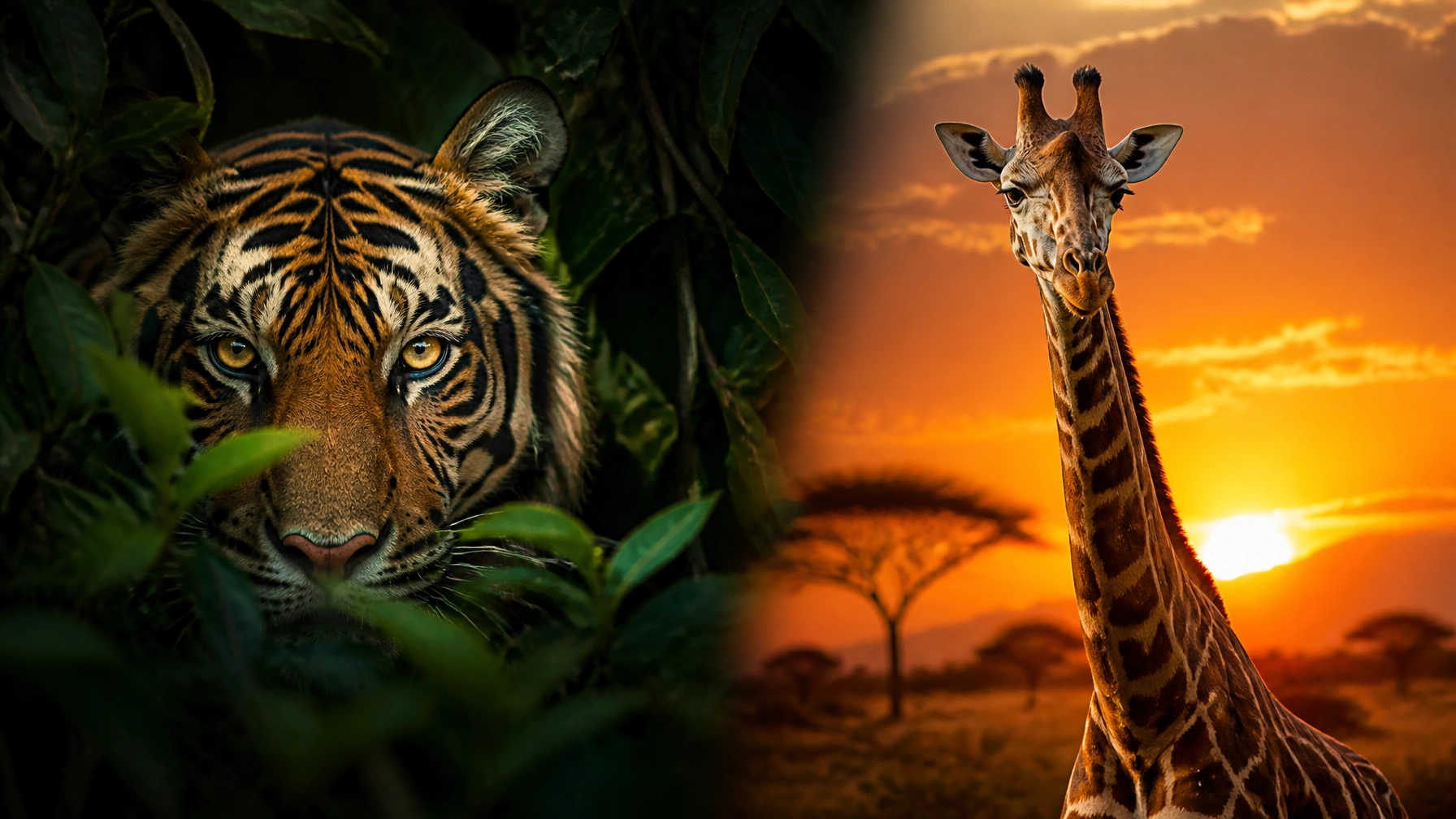
7 Mistakes You’re Making with Tiger and Giraffe Stock Photos (and How to Fix Them)
Stock photography saves time.
Stock photography saves money.
Bad stock photography ruins brands.
Wildlife is difficult.
Tigers and giraffes are iconic.
They are also the most misused.
Your project needs authenticity.
Your audience knows the difference.
Here are the seven most common mistakes and how to fix them.
1. The "Ghost Eye" Mistake
The eyes are everything.
In wildlife photography, if the eyes aren't sharp, the photo is useless.
Many stock photos focus on the fur or the nose.
The result is a "ghostly" look.
The Fix:
- Zoom to 100%.
- Check the pupils.
- Ensure the amber of the tiger’s eye is crisp.
- Look for the "catchlight": the small reflection of light in the eye.
- This creates life.

2. Ignoring "Look Space"
Animals move.
Animals look at things.
A common mistake is placing the animal dead center.
Or worse, facing the edge of the frame.
It feels cramped.
It feels trapped.
The Fix:
- Use the Rule of Thirds.
- Give the giraffe space to "look" into.
- Give the tiger space to "walk" into.
- Visual tension creates engagement.
- Browse our landscape collection for proper composition.
3. Harsh Midday Lighting
Sunlight at noon is flat.
It creates deep, black shadows in eye sockets.
It washes out the intricate patterns of a giraffe’s coat.
It makes a tiger look plastic.
The Fix:
- Prioritize "Golden Hour" shots.
- Look for soft, side-angled light.
- Warm tones enhance orange fur.
- Shadows should be soft, not harsh.
- Professional photography uses natural light to add depth.
4. Biological Context Errors
Tigers are Asian.
Giraffes are African.
A tiger in an African savanna is a mistake.
A giraffe in a dense jungle is a mistake.
Your audience will notice.
Credibility is fragile.
The Fix:
- Check the flora.
- Ensure the background matches the species.
- Tiger: Dense forests, tall grass, wetlands.
- Giraffe: Open savanna, acacia trees, dry scrub.
- Authenticity drives trust.

5. The "Clipped Anatomy" Crop
Giraffes are tall.
Tigers have long tails.
Standard stock crops often cut off the ossicones (horns) of a giraffe.
Or the tip of a tiger's tail.
This feels accidental.
It feels unprofessional.
The Fix:
- Choose images with "breathing room."
- Ensure all key anatomical features are present.
- If you must crop, crop intentionally.
- Never cut at the joints.
- Respect the animal's silhouette.
6. Relying on the "Roar" Cliché
Every tiger stock photo seems to be a roar.
Every giraffe is looking straight at the camera.
These are clichés.
They feel staged.
They feel "stocky."
The Fix:
- Look for candid moments.
- A tiger resting in the shade.
- A giraffe drinking at a waterhole.
- Quiet power is often more effective than loud action.
- Explore our Giraffe listings for authentic behavior.
7. The Wrong Format for the Platform
Social media is vertical.
Web headers are landscape.
Trying to crop a landscape tiger into a vertical TikTok post fails.
You lose the subject.
You lose the quality.
The Fix:
- Plan your format.
- Zoo Imagery offers both landscape and portrait photography.
- Vertical shots capture the scale of a giraffe.
- Landscape shots capture the environment of a tiger.

The Value of "Presented by" Pages
Branding shouldn't be intrusive.
We offer "Presented by" animal pages.
A subtle, powerful way to align your brand with nature.
Choose a species:
A sponsored species spotlight shows commitment.
It moves beyond simple stock.
It tells a story of conservation and support.
User-Generated Content with ZooMedia.us
People take photos.
Guests at zoos and aquariums take millions of them.
ZooMedia.us leverages this.
It allows guests to share their own photos easily.
Real moments.
Real engagement.
Real ROI.
It turns visitors into marketers.
Summary
Quality over quantity.
Authenticity over clichés.
Details matter.
- Sharp eyes.
- Correct lighting.
- Biological accuracy.
- Proper formatting.
Professional animal imagery doesn't just fill space.
It builds a connection.
Ready to elevate your project?
Visit Zoo Imagery to explore our library.
Connect with us on LinkedIn for daily insights.


