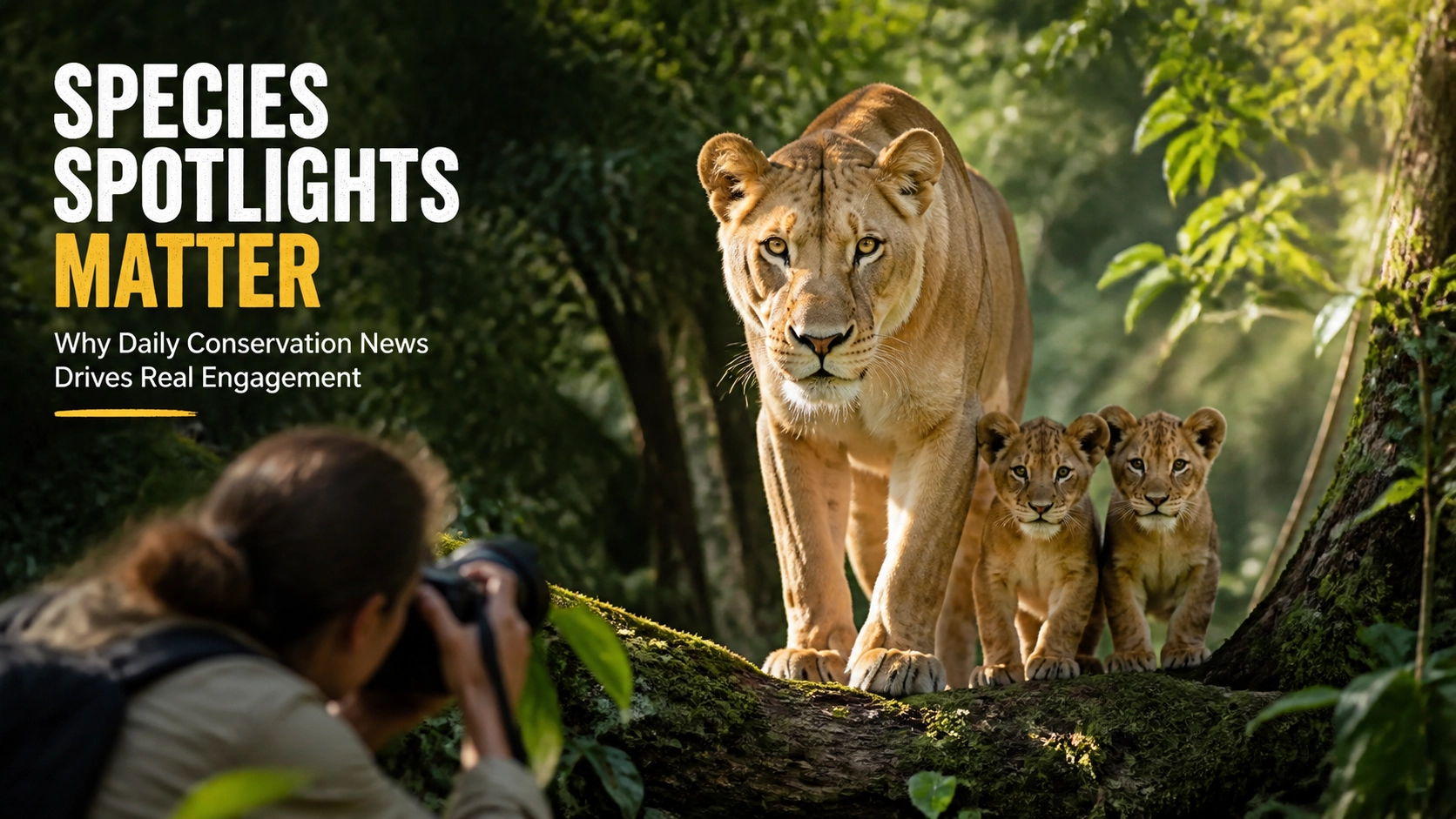
Species Spotlights Matter: Why Daily Conservation News Drives Real Engagement
Statistics are hard to love.
"Biodiversity loss" is a broad concept. It feels distant. It feels overwhelming. Most people don’t know how to react to a percentage. They don't know how to help a graph.
But people can love a single animal. They can connect with a specific story.
At Zoo Imagery, we believe in the power of the specific. We focus on species spotlights. We focus on daily conservation news. We do this because it works. It turns vague concern into real engagement.
The Power of One
Generalities fail. Specifics succeed.
Consider the Urban Caracal Project in Cape Town. Researchers didn't just talk about "urban wildlife." They talked about the caracal. They showed its tufted ears. They told its story.
The results were clear:
- Global search interest for "caracal" doubled.
- Public participation spiked.
- People reported sightings.
- People felt something.
The most common word in positive comments was "beautiful." The most common word in negative comments was "sad." People were no longer looking at data. They were looking at a protagonist.

Daily News Creates Habits
A single viral post is a flash in the pan. It gets likes, then it disappears.
Real behavior change requires repetition. This is why daily conservation news matters.
Daily updates work like a drip campaign. Small touches. Repeated exposure. Constant presence. This cadence normalizes caring. It makes conservation part of a daily routine rather than a monthly chore.
Research shows that digital platforms can:
- Increase funding.
- Drive policy changes.
- Shift pro-conservation behaviors.
The Black Bass Conservation Committee is a great example. Since 2011, they have used social media for simple, jargon-free posts. They didn't post once. They posted consistently. Now, they have a community of anglers who act as stewards.
Consistency builds trust. Trust builds action.
Moving Beyond the Screen
Awareness is only the beginning. The goal is impact.
A well-executed species spotlight moves people to act. It changes the world outside the phone.
Legislative Change
WWF ran a campaign for the vaquita. They used Instagram and Twitter. They used high-quality visuals. They generated 200,000 citizen responses. This contributed to Mexico changing its legislation.
Scientific Support
Florida International University used storytelling to share shark research. Since 2016, every shark species added to CITES (the convention on international trade) has ties to this science-plus-storytelling approach.
Citizen Science
NOAA has a "Species in the Spotlight" program. It targets the most at-risk marine species. In one year, they received 9,000 monk seal sightings from the public. This happened because the public was informed. They were watching. They were engaged.

The Role of Aesthetics
Visuals are the hook.
At Zoo Imagery, we focus on the image. A striking photograph captures attention in a way text cannot.
The caracal study confirmed this. Using an aesthetic species is the most effective way to capture public attention. People are drawn to beauty. They are drawn to high-quality digital media.
When you combine a professional image with a daily update, you create a narrative arc.
- A struggle.
- A small win.
- A setback.
- A hope.
This is storytelling. It isn't just a photo. It is a window into a life.

ESG-Aligned Storytelling
Many organizations want to support conservation. They want to show their values. We help them do this through "Presented by" animal pages and sponsored species spotlights.
This isn't about complex corporate jargon. It is about transparency. It is about simple, honest reporting on where support goes.
- Focus on the animal.
- Focus on the habitat.
- Focus on the solution.
By highlighting a specific species, companies can show a direct link between their actions and a tangible outcome. It makes their commitment real to their audience.
Zoo Imagery Milestones
We are growing. Our library of stock photography is expanding.
Our goal is simple: provide the best digital media for zoos, aquariums, and conservationists.
We have hit several milestones recently:
- Expanded our species database.
- Partnered with more conservation storytellers.
- Simplified our user experience.
We believe that high-quality media should be accessible. It should be used to tell the stories that matter most. We are proud to be the visual engine behind these conservation narratives.
How to Build an Effective Spotlight
If you are sharing conservation news, keep these principles in mind:
-
Use an Individual Hook
Pick a species. Or even a specific, named animal. Give your audience a character to root for. -
Post Daily
Consistency is better than intensity. A short daily update is more effective than a long monthly newsletter. -
Provide a Micro-Action
Don't just give news. Give a task.
- "Report a sighting."
- "Share this photo."
- "Sign this petition."
- "Change one purchase."
-
Stay Simple
Avoid jargon. Avoid industry buzzwords. Speak like a human. -
Focus on Quality
One great image is worth more than ten mediocre ones. Quality imagery builds professional credibility.

A Simple Truth
Conservation is a marathon. It is won in small steps.
Species spotlights provide the focus. Daily news provides the rhythm. Together, they create a community of people who care.
When people care, they act.
We provide the imagery to make people look. We provide the stories to make them stay.
Join the Story
We invite you to explore our work. See how high-quality imagery can transform your conservation messaging.
Whether you are a zoo, an aquarium, or a brand looking to make an impact, we are here to help.
- Visit our website: zooimagery.com
- Follow our journey on LinkedIn
- Reach out to us: Contact Zoo Imagery
Species spotlights matter. Daily news drives engagement. Let's tell these stories together.


