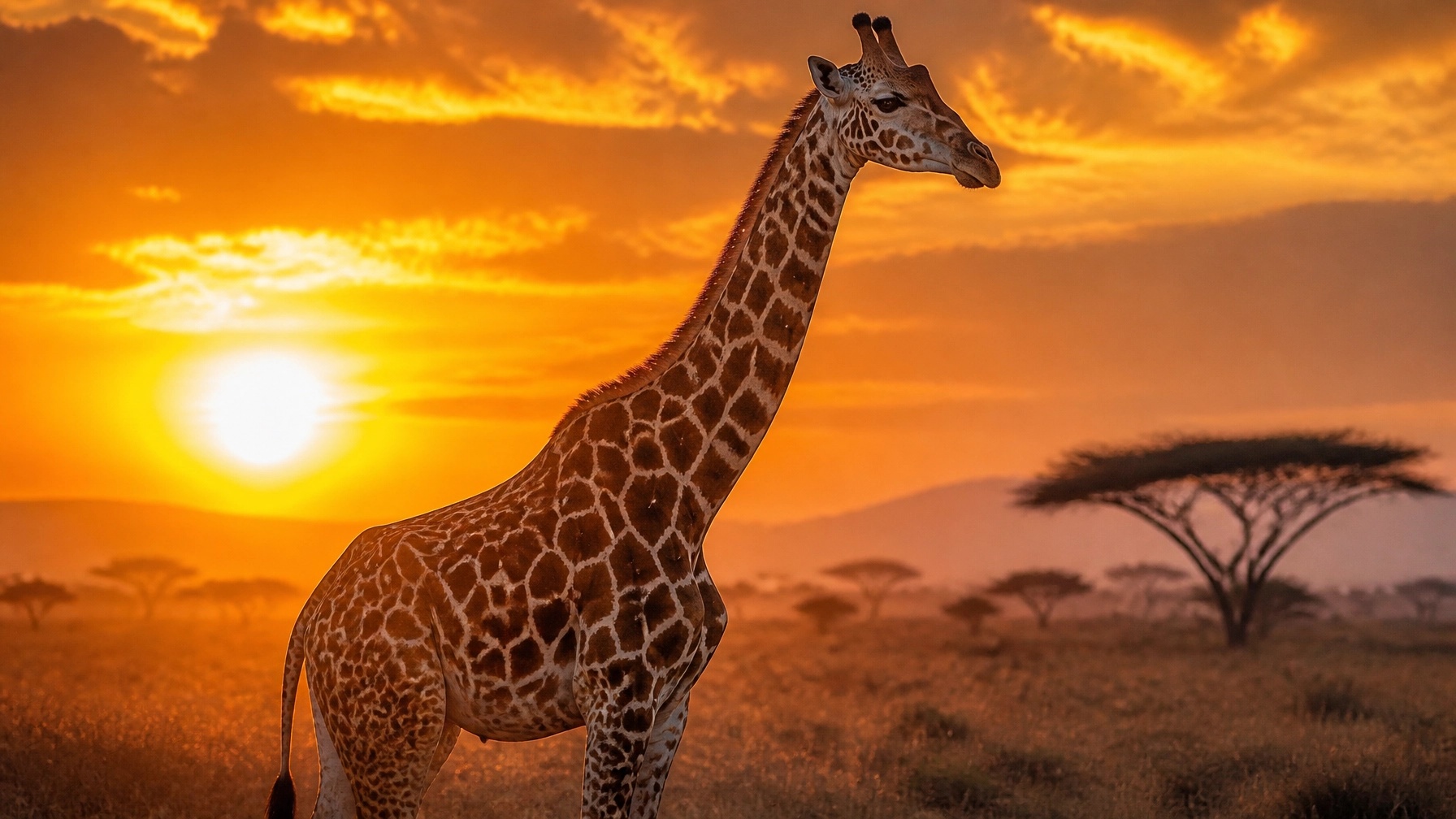
Presented by: Giraffes : Reaching New Heights in Conservation
Overview
Giraffes.
Tallest land mammals.
Iconic silhouettes.
Often overlooked in conservation.
Recent data shows a shift.
Populations are recovering.
The Four Species
Historically considered one species.
Now classified as four distinct species.
Genetic testing confirmed the split.
Each occupies a specific region.
Each has unique markings.
1. Masai Giraffe
- Scientific Name: Giraffa tippelskirchi
- Location: Kenya, Tanzania, Zambia.
- Status: Endangered.
- Current Trend: Stable to slowly increasing.
- Visuals: Darker spots with jagged, leaf-like edges.
- Fact: The largest of the four species.
2. Northern Giraffe
- Scientific Name: Giraffa camelopardalis
- Location: Central and Northern Africa (Chad, Niger, Uganda).
- Status: Critically Endangered.
- Current Trend: Increasing.
- Sub-species: Includes the West African and Nubian giraffe.
- Fact: Most threatened of all large mammals.
3. Reticulated Giraffe
- Scientific Name: Giraffa reticulata
- Location: Northern Kenya, Somalia, Ethiopia.
- Status: Endangered.
- Current Trend: Increasing.
- Visuals: Sharp, polygonal liver-colored spots.
- Fact: 31% population increase since 2020.
4. Southern Giraffe
- Scientific Name: Giraffa giraffa
- Location: Southern Africa (Namibia, South Africa, Botswana).
- Status: Least Concern.
- Current Trend: Increasing.
- Population: Over 68,000 individuals.
- Fact: Numbers have more than doubled in 30 years.

Population Trends
Conservation works.
Data from the Giraffe Conservation Foundation (GCF) confirms it.
Three of the four species show positive growth.
One species remains stable.
Overall numbers are rebounding.
Total wild population: ~140,000.
The Breakdown
- Positive growth: Northern, Reticulated, Southern.
- Stable: Masai.
- Success story: Southern giraffes increased 50% in five years.
- Recovery: Reticulated giraffes up by nearly one-third since 2020.
Movement and Migration
Giraffes are mobile.
They require vast ranges.
Seasonal changes drive movement.
Resources determine the path.
- Migration distance: Up to 60 km seasonally.
- Drivers: Water availability, foliage quality.
- Obstacles: Fencing, human infrastructure, habitat loss.
- Impact: Movements connect fragmented ecosystems.

Technology in the Field
Conservation is no longer just observation.
It is data-driven.
Precision tracking is standard.
Giraffe Africa Database (GAD)
The GAD is a centralized platform.
Operated by the GCF.
It standardizes survey results across the continent.
Stakeholders:
- Governments.
- NGOs.
- Researchers.
- Protected Area Managers.
Functions of GAD
- Collate survey data.
- Track population status.
- Identify five-year trends.
- Inform National Giraffe Conservation Strategies.
- Evaluate reintroduction success.

Conservation Actions
Success is not accidental.
Strategic intervention drives numbers.
- Translocations: Moving giraffes to safe, historical habitats.
- Ranger Patrols: Protecting populations from illegal poaching.
- Community Engagement: Involving local populations in wildlife management.
- Policy Support: Working with African governments on national strategies.
- Habitat Restoration: Clearing invasive species to allow acacia growth.
The Role of Imagery
Visuals matter.
Photos tell the story of survival.
They drive engagement.
They secure funding.
At Zoo Imagery, we provide these tools.
Why Quality Matters
- Clarity: Clear images identify individual patterns.
- Scale: Drone photography tracks herd size.
- Connection: Close-ups foster empathy for the species.
- Accuracy: High-resolution data supports scientific reporting.
For Creative Professionals
Our library features giraffes in all categories.
Masai, Southern, Reticulated.
Landscape and portrait.
Ready for use in conservation campaigns.
Ready for educational projects.

Our Impact
Zoo Imagery supports the mission.
We simplify the search for professional animal photography.
Our platform saves time.
Our platform saves money.
Visuals belong in every conservation conversation.
ZooMedia.us App
Engagement for zoos.
Engagement for aquariums.
User-generated content.
Guests share photos instantly.
Drive ROI.
Track real-time engagement.
Turn visitors into advocates.
Summary
Giraffes are reaching new heights.
The trends are positive.
The technology is advancing.
The photography is essential.
Key Takeaways
- Four species exist.
- Three species are increasing.
- 60 km migrations occur.
- GAD monitors progress.
- Conservation works.
Learn More
Visit our site for high-quality imagery.
Support wildlife through visual storytelling.
Stay updated on our progress.
Explore more: zooimagery.com
Follow us: Zoo Imagery on LinkedIn


