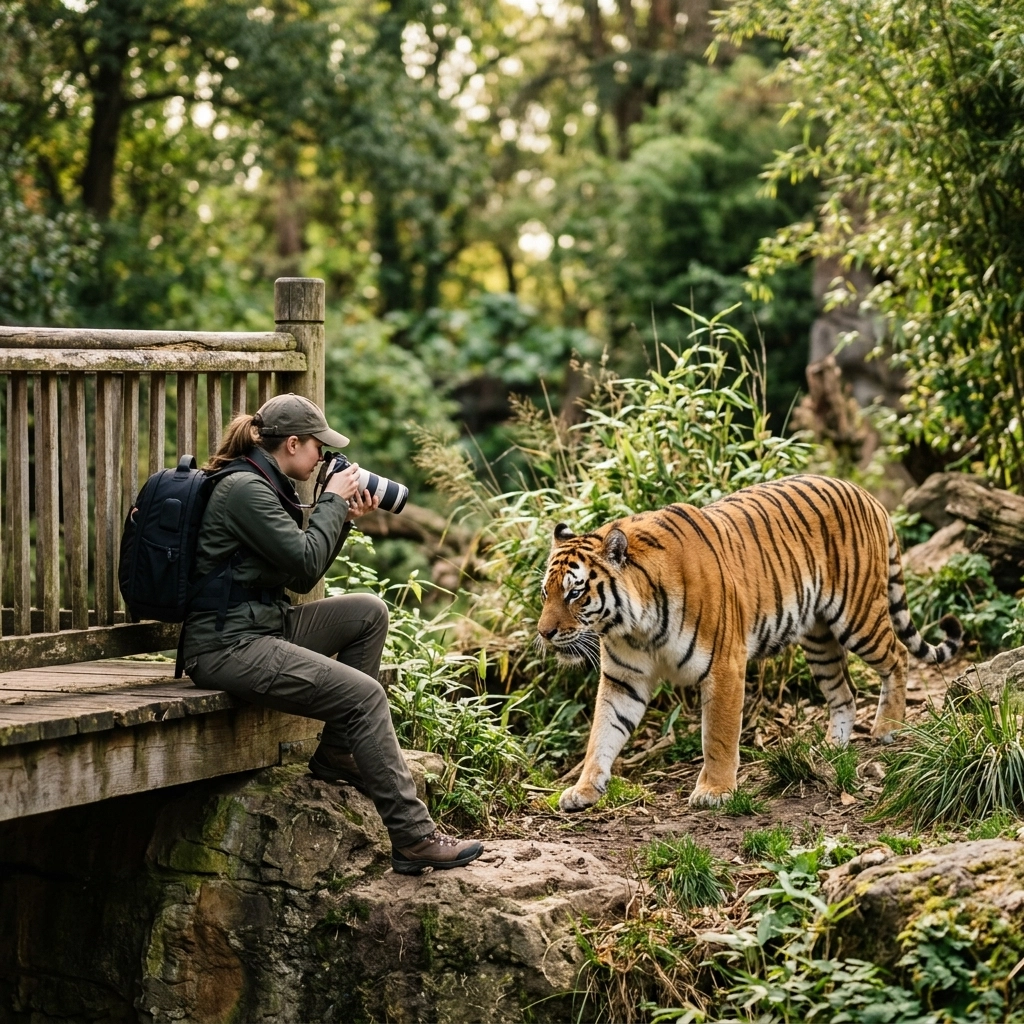
7 Mistakes You’re Making with Zoo Animal Photos (and How to Fix Them)
Taking photos at the zoo seems easy. The animals are there. They don’t run away into the forest. You have clear paths.
But most zoo photos look like "zoo photos." They feel clinical. They feel like snapshots. They don't capture the spirit of the animal.
At Zoo Imagery, we see thousands of photos. We help zoos turn these images into "Presented by" animal pages and sponsored species spotlights. We know what works for stock photography and what doesn't.
If your photos feel flat, you are likely making one of these seven mistakes.
Here is how to fix them.
1. The "Fence" Problem
The biggest giveaway of a zoo photo is the barrier. Fences, bars, and mesh distract the viewer. They remind people of captivity. This kills the narrative of the photo.
The Mistake: Shooting with a deep depth of field that keeps the fence in focus.
The Fix:
- Aperture: Use your widest aperture (lowest f-number like f/2.8 or f/4). This creates a shallow depth of field.
- Proximity: Get your lens as close to the fence as safely possible.
- Distance: Choose animals that are standing far away from their back fence.
- The Result: The fence disappears into a soft blur. The animal stands out.

2. Using On-Camera Flash
Flash is the enemy of quality zoo photography.
The Mistake: Leaving your camera on "Auto" so the flash pops up.
The Fix:
- Turn it off: Flash startles animals. It is often prohibited.
- Glass reflections: If you are shooting through glass, a flash will reflect right back into the lens. It creates a white orb that ruins the shot.
- Natural light: Use the sun. If it’s dark, increase your ISO.
- Rubber lens hoods: If you must shoot through glass, use a rubber lens hood. Press it against the glass. This blocks out reflections from the walkway behind you.
3. Ignoring the Eyes
A photo without sharp eyes is a photo for the trash bin. The eyes are the connection point between the subject and the viewer.
The Mistake: Letting the camera autofocus on the animal's shoulder or the grass in front of them.
The Fix:
- Single point focus: Don't let the camera choose where to focus. Set your camera to a single focus point.
- Aim for the eye: Place that point directly on the eye closest to the camera.
- Animal Eye AF: If your camera has modern "Animal Eye Tracking," use it. It is a game-changer for primates and big cats.
- Sharpness: If the eye isn't sharp, the photo has no soul.

4. Man-Made Background Clutter
A majestic tiger looks less majestic when there is a bright red trash can or a "Do Not Feed" sign behind its head.
The Mistake: Focusing so much on the animal that you forget to look at what is behind them.
The Fix:
- Check the corners: Before you click the shutter, scan the edges of your frame.
- Move your feet: Sometimes moving three feet to the left hides a concrete wall behind a tree branch.
- Wait: Animals move. Wait for them to step into a spot with a natural-looking background.
- Tight framing: If the enclosure is small, zoom in. A tight headshot eliminates the background entirely.

5. Poor Composition and "Chopped Limbs"
Composition is about balance. Many beginners put the animal’s nose right in the center of the frame.
The Mistake: Centering everything or accidentally cutting off a tail or a hoof.
The Fix:
- Rule of Thirds: Place the animal's eyes along the top third of the frame.
- Look Room: Give the animal space to "look into." If a lion is looking to the right, place the lion on the left side of the frame. This creates a sense of direction.
- Don't crop limbs: Check your edges. Don't cut off the tips of ears or the ends of tails. If you want a close-up, be intentional. Crop at the chest or neck, not the joints.
6. Using the Wrong Shutter Speed
Animals move. Even when they seem still, they twitch, blink, or chew.
The Mistake: Using a shutter speed that is too slow, resulting in "soft" images.
The Fix:
- Minimum speed: For stationary animals, stay above 1/250s.
- Active animals: For monkeys, birds, or playing cubs, go to 1/1000s or faster.
- Telephoto shake: If you are using a long zoom lens (like a 300mm or 400mm), you need a high shutter speed just to counteract your own hand-shake.
- Freeze the action: Sharpness comes from speed.

7. The "Snap and Run" Mentality
Most people walk up to an exhibit, take one photo, and move on.
The Mistake: Being impatient. The best moments happen when you wait.
The Fix:
- Observe first: Put the camera down for five minutes. Watch the animal's patterns. Where do they like to sit? How do they interact with their environment?
- Wait for the "Golden Moment": A yawn, a stretch, or a look toward the light.
- Quality over quantity: One incredible photo is better than fifty mediocre ones.
Why Quality Photos Matter for Zoos
At Zoo Imagery, we believe great photography does more than just look pretty. It drives business.
When a zoo has high-quality, professional-grade stock photography, they can offer better value to their corporate partners. This is where our "Presented by" animal pages come in.
Imagine a local company sponsoring a "Species Spotlight" for the Snow Leopard. If the photo used is grainy, shows a fence, and has a trash can in the background, it reflects poorly on the sponsor.
But a crisp, professional image: where the leopard looks like it’s in the wild: creates an emotional connection. It makes the sponsorship feel prestigious. It helps with conservation storytelling.
We help zoos manage these assets. We ensure your digital media is ready for:
- Website animal pages.
- Social media campaigns.
- Corporate sponsorship decks.
- ESG-aligned marketing.
If you are a zoo professional looking to upgrade your digital presence, or a photographer wanting to contribute to conservation efforts, let's talk.
Visit zooimagery.com to see how we are changing the way zoos manage their visual assets.
Follow our journey and see more tips on our LinkedIn profile.

Keep it simple. Keep it sharp. Focus on the animal.
: Dan Kost, CEO, Zoo Imagery


